How It Works Pricing Learn Log In Sign Up
Non-Accountant Friendly Financial Analysis

Your Numbers,
Finally Explained

Stop staring at confusing spreadsheets. Upload your financials and get a report that actually makes sense, written like a friend explaining over coffee.

Bank-level encryption No accounting jargon Your data stays private

Sound Familiar?

"I do not understand my own financials"

Your accountant sends reports full of jargon. You nod along, pretending you get it. You see numbers but have no idea if they are healthy or a warning sign.

"Profitable on paper, but where is the cash?"

The P&L says you made money. Your bank account disagrees. Should you hire? Expand? You are guessing, not knowing.

Finance, Translated

Upload your data. Get clarity. Take action.

What You Get Now
Revenue: $1,245,892
COGS: $891,204
Gross Margin: 28.48%
EBITDA: $156,402
DSO: 47 days
Current Ratio: 1.2
"What does this even mean?"
What PlainFinancials Gives You

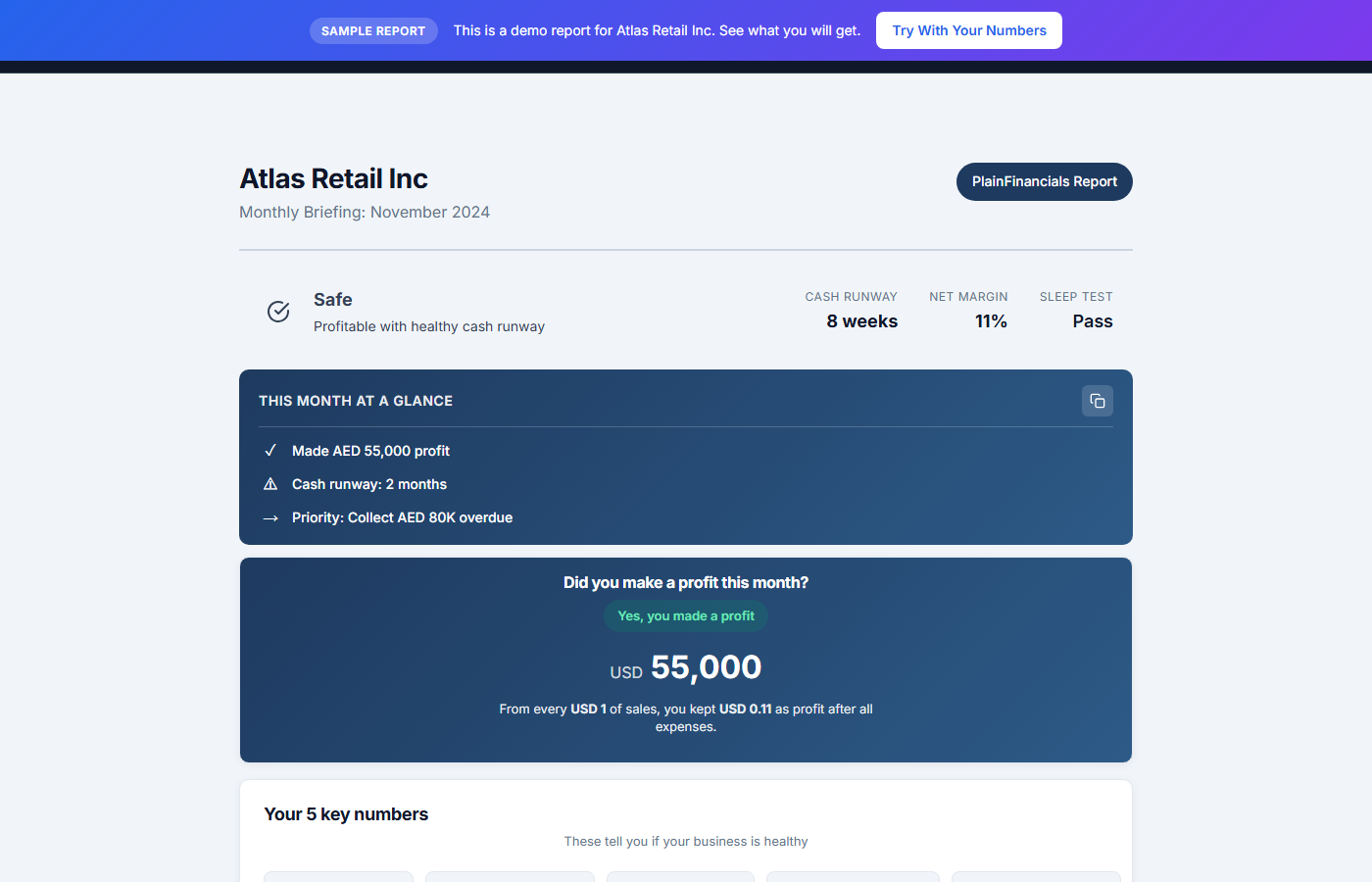
You made $156K profit, and that is good!

But your margins dropped 2% because supplier costs went up.

Cash is tight: you have 6 weeks of runway.

Customers take 47 days to pay you. That is too slow.

Action: Chase the $78K in overdue invoices this week.

"Now I know what to do!"

How It Works

1

Enter Your Numbers

Key in 5-6 figures from your P&L and balance sheet. Takes about 2 minutes.

2

We Analyze

We crunch the numbers, calculate key ratios, and identify what matters most for your business.

3

Get Your Report

A clear, simple briefing in plain English. What happened, why it matters, and what to do.

4

Take Action

Get 3 specific actions for this week. Share the report with partners or your accountant.

What You Get

Plain English Reports

Clear briefings that tell you exactly what is happening in your business, in words you understand.

3 Actions This Week

Not just "here is what happened", but specific actions you can take right now.

Health Indicators

Instant traffic-light view: Safe, Tight, or Danger. Know where you stand at a glance.

Cash Flow Forecast

See where your cash is heading over the next 3 months based on your payment patterns.

Industry Benchmarks

Compare your margins and ratios to typical businesses in your industry.

Share with Banks & Partners

Download a clean PDF summary to share with your bank, investors, or business partners.

Simple Pricing

Start free. Upgrade when you need more.

Free
$ 0

Try it out

  • 1 full report (lifetime)
  • Full financial analysis
  • Health indicators
  • Cash forecast
  • Industry benchmarks
  • No PDF download
  • 30-day history only
Get Started
Pro
$ 85 /month

For growing businesses

  • 20 reports per month
  • Full financial analysis
  • Health indicators
  • Cash forecast
  • Industry benchmarks
  • PDF downloads
  • 12-month history
  • Scenario analysis
  • Branded PDF reports
  • Team access (up to 5)
  • Priority support
Get Started

$850/year (save 2 months)

Need a human to walk you through it?

Book a 30-minute call with a chartered accountant who speaks plain English.

Why We Built This

Financial reports should inform decisions, not confuse them.

Most business owners are brilliant at what they do: running operations, serving customers, building products. But they never learned to read a balance sheet, and traditional financial reports were not designed for them.

PlainFinancials bridges the gap between accounting output and business decisions. We take the numbers your accountant produces and translate them into clear insights you can act on.

No jargon. No confusion. Just clarity.

Built for SMEs Works globally Multi-currency

Common Questions About Financial Statements

This is one of the most common frustrations for business owners. Profit is an accounting concept that doesn't account for timing—when customers pay you vs when you pay suppliers. Your P&L might show profit, but if customers owe you money or you've stocked up on inventory, that cash isn't in your bank yet. PlainFinancials shows you exactly where your cash is tied up with a simple "cash bridge" explanation.

Focus on: Revenue (are sales growing?), Cost of Goods Sold (what it costs to deliver), Operating Expenses (overhead), Net Profit (what's left), Cash in Bank (can you pay bills?), and Accounts Receivable (money owed to you). These six numbers tell the complete story of your business health. Upload them to PlainFinancials and get a plain English explanation of what they mean together.

Start with three things: Are you profitable (net profit line)? Do you have enough cash to pay upcoming bills? Are customers paying you on time? Your accountant's report contains all this, but it's buried in accounting jargon. PlainFinancials reads your report and highlights exactly what changed and what it means for your business—no accounting knowledge needed.

Cash runway is how many months your business can survive on its current cash, assuming no new income. Calculate it by dividing your cash in bank by your average monthly expenses (or "burn rate"). If you have $30,000 cash and spend $10,000/month, you have 3 months of runway. PlainFinancials calculates this automatically from your numbers and warns you when runway gets dangerously low.

Three common reasons: customers are paying late (your money is stuck in receivables), you're holding too much inventory, or you're paying suppliers faster than customers pay you. This timing mismatch is called the "cash conversion cycle." PlainFinancials analyzes your numbers and tells you exactly which of these is causing your cash crunch—and what to do about it.

Look at your current cash balance, subtract any bills due in the next 30-60 days, and compare that to your monthly operating costs. If you have less than 2-3 months of expenses covered, you need to act fast. PlainFinancials does this math for you and gives you a clear "cash forecast" showing your projected balance for the next 3 months.

A profit and loss statement (P&L) shows your business income minus expenses over a period—usually a month or year. It answers: "Did I make or lose money?" The top shows revenue, the middle shows costs (goods sold, salaries, rent, etc.), and the bottom shows net profit or loss. PlainFinancials takes your P&L and explains each section in plain English, highlighting what's changed and why it matters.

Watch these four: Revenue (is it growing?), Gross Margin (revenue minus cost of goods—are you pricing right?), Operating Expenses (is overhead under control?), and Net Profit (what's actually left). Compare each month to the previous month and same month last year. PlainFinancials highlights these comparisons automatically and tells you whether you're trending better or worse.

Ask three simple questions: Am I profitable (net profit is positive)? Can I pay my bills for the next 3 months (cash runway)? Are customers paying me on time (receivables aren't growing out of control)? If yes to all three, you're in decent shape. PlainFinancials gives you a simple health score based on these factors and compares you to industry benchmarks—no finance degree required.

Ask for three reports: Profit & Loss Statement (shows if you made money), Balance Sheet (shows what you own and owe), and Aged Receivables (shows who owes you money and how overdue). Most accounting software generates these automatically. Upload any of these to PlainFinancials and get a one-page summary explaining what it all means in plain English.

A balance sheet shows what your business owns (assets) vs what it owes (liabilities) at a specific moment. Assets include cash, inventory, and money customers owe you. Liabilities include loans, unpaid bills, and money you owe suppliers. The difference is your equity—what the business is actually worth. PlainFinancials reads your balance sheet and highlights the key numbers that affect your cash and survival.

Accounts receivable (AR) is money customers owe you for work you've already done or products you've delivered. It matters because high AR means your cash is stuck with customers instead of in your bank. If AR keeps growing, you're essentially funding your customers' businesses. PlainFinancials tracks how long customers take to pay (DSO) and warns you when receivables are hurting your cash flow.

Three practical ways: (1) Get paid faster—send invoices immediately and follow up on overdue payments, (2) Slow down payments—negotiate longer payment terms with suppliers, (3) Reduce inventory—order smaller quantities more often instead of big bulk orders. PlainFinancials analyzes your numbers and tells you exactly which of these will have the biggest impact on your specific situation.

It varies by industry: Retail typically sees 2-5% net margin, Services 10-20%, Technology 15-25%, and Food & Beverage 3-10%. Gross margin (before overhead) is usually much higher—25-50% for most businesses. PlainFinancials compares your margins to industry benchmarks and tells you if you're pricing right or if costs are eating into your profit.

PlainFinancials is designed specifically for non-accountants. Unlike tools like QuickBooks or Xero that create financial statements, PlainFinancials translates numbers into insights with simple language reports. It features visual charts showing profit trends, automatic categorization of what matters, and alerts when something needs attention—all without accounting jargon. It's beginner-friendly and requires no accounting knowledge.

While accounting software like QuickBooks, Xero, Wave, and FreshBooks generate your financial statements, PlainFinancials is the translation layer that explains what those statements mean. It takes your P&L, balance sheet, and cash flow data and converts accounting jargon into beginner-friendly insights—perfect for business owners who need clarity without learning accounting.

No. Your accountant handles compliance—VAT filing, bookkeeping, annual returns. We translate their output into insights you can actually use for decisions. Think of us as the explanation layer between your accountant's reports and your business decisions.

Absolutely. We use bank-level encryption, don't store your data longer than needed, and never share it with third parties. You can delete your data anytime. Your numbers stay yours.

Ready to Finally Understand Your Numbers?

Try PlainFinancials free. Get your first report in 2 minutes.

Analyze My Numbers

No signup required. No credit card. Just clarity.

Wait! See a Real Example First

Before you go, check out what your financial report would look like. Takes 30 seconds. No signup required.

See Sample Report